


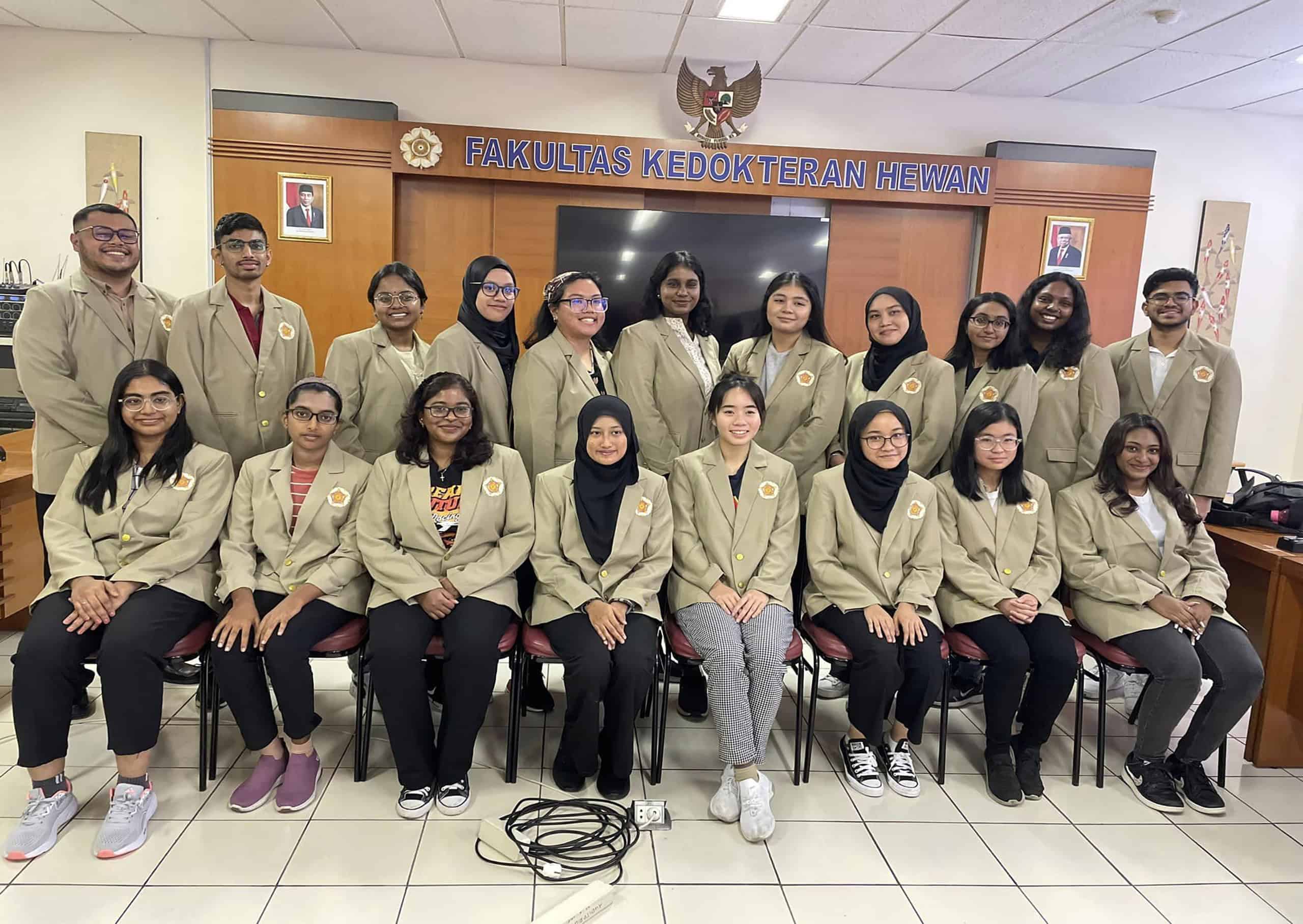
Are you passionate about animals and interested in becoming a veterinary doctor?
A complete guide to pursue Degree in Veterinary Medicine (DVM)
To gain admission, it’s essential to meet the minimum requirements set by the institution. This usually includes academic qualifications, such as specific grades or courses completed, and sometimes other criteria like language proficiency or extracurricular activities.
A. SPM/Olevel
B. Pre- University course :


Here are some institutions offering the Doctor of Veterinary Medicine (DVM) course
Local Public Universities (IPTA)
Local public universities typically have a centralized admission process through the Malaysian Higher Education Ministry’s admission system, known as UPUOnline. However, some universities also offer Direct Intake pathways, which provide an alternative route for local students to gain admission without competing in the traditional centralized process.
Local Public Universities Intake admission through :
Securing a seat in local public universities can indeed be highly competitive. This is due to the limited number of slots available and the high demand from a large pool of applicants. This makes the opportunity to study abroad, such as in Indonesia, particularly attractive for those looking to pursue veterinary studies.
Recognised & Approved by Malaysian Veterinary Council
INDONESIA
- English Medium
Gadjah Mada University (UGM)
Airlangga University
(UNAIR)
Institut Pertanian Bogor
(IPB)
Recognised by :
Malaysian Veterinary Council (MVC)
Jabatan Perkhidmatan Awam (JPA)

MQA
Why Indonesia?
Indonesian Local University Admission System
International Students :
Gelombang 1 (G1) – Jan/Feb
Gelombang 2 (G2) – April/May
Gelombang 3 (G3) - July
Choices of Universities
Education City : Home for more than one hundred Higher Education Institutions.
Harmonious & Tolerant Life : Comfortable and serene campus environment dominated by expansive green open spaces.
Metropolis Smart City : One of the fastest growing metropolitan areas in Southeast Asia and become one of the most organized metropolitan cities in Indonesia with the cleanest air quality.
Academic Curriculum / Study Course
11 semester which consist of :
Veterinary Medicine Study Programme (8 semesters)
Veterinarian Profession Education Study Program (VPESP) (3 semesters)
GADJAH MADA UNIV
(UGM)
INSTITUT PERTANIAN BOGOR
(IPB)
Starting sem 3, student will enter Veterinary Faculty
AIRLANGGA UNIV
(UNAIR)
Starting sem 3, student will enter Veterinary Faculty

Why Medic Pro Link?
Provisional Timeline
Frequently Asked Questions
All 3 recognised universities are Indonesian Public universities.
Gadjah Mada and Bogor Agri University were the first to be approved by JPA in 1975.
Medic Pro Link has been appointed by various Indonesian Public Universities over the pass 20 years as University Selection Test Coordinator for Malaysian candidates. Some of the prominent universities are Gadjah Mada University, Brawijaya University, Bogor Agri University, USU and Andalas University. Medic Pro Link has been serving Gadjah Mada Uni (Largest Public University of Indonesia) as Selection Test Coordinator for Malaysian candidates since 2008.
*SPM : Credit in Bio, Science & Maths.
*Pre-U : Minimum CGPA 2.0 or equivalent in Foundation in Science, STPM, Matriculation, Diploma, A’Level, IB, CPU, AUSMAT and such.
Successful candidates usually will fly between end July and early August of the intake year.
Only one intake per year. Same as our own public universities.
Medic Pro Link with extensive experience over 20 years as University Selection Test Coordinator will conduct highly effective classes to enable eligible candidates to pass the selection test with ease. Candidates will be fully guided to face various aspects of test such as Science/Maths knowledge, Fast Thinking, Course Specific Knowledge, Interview and as such.
Candidates are advised to register a few months in advance prior to University Selection Test in order to have sufficient time for test preparation.
No. Every Indonesian University will conduct their own respective Selection Test with different timing.
The degree program is a combination of 8 semesters (4 years) of theoretical study and 50 Weeks of Professional Phase.
Starts with minimum estimate tuition fee of RM103k for whole study.
Generally, the cost of living to study degree in Indonesia is considered to be cheaper than Malaysia. The cost of food and accommodation are much more affordable in comparison.
All new students will be provided with hostel. Usually hostels are 1 or 2 person in a room with attached bathroom/toilet.
Being top public universities, they are included in various international recognition listings such as WHO and QS Ranking.
Historical Comparison of Indonesian’s Pioneer Veterinary Faculties: GADJAH MADA, AIRLANGGA & BOGOR AGRICULTURAL UNIVERSITY
The development of veterinary education in Indonesia has unfolded in three major academic centres—Bogor, Jogjakarta, and Surabaya—each contributing to national animal health capacity in distinct historical periods.
Dr Johannes Alexander Kaligis, graduated in 1910 as Indonesia's first veterinarian. Alongside Dr Kaligis, another Indonesian veterinarian who graduated from IVS/NIVS is Prof. drh. Soeparwi who later became the first dean of the Gadjah Mada Faculty of Veterinary Medicine.
- University of Gadjah Mada (UGM, 1949)
First National (Post-Independence) Veterinary Faculty (1949).
Timeline summary:
Vet Lab & Vet Course (1907) – Bumi Vet School (1910) – NIVS (1914) – PTKH (1946) – UGM Vet Faculty (1949).
UGM’s veterinary faculty origins trace back to 20 September 1946, when the Republic of Indonesia—still fighting for sovereignty—established the Perguruan Tinggi Kedokteran Hewan (PTKH) which was moved from Taman Kencana to Klaten and finally to Jogjakarta. When UGM was officially founded on 19 December 1949, this veterinary school became one of its earliest faculties, making it the first Indonesian-founded veterinary institution, created by Indonesians for national needs during the early independence period.
The Faculty of Veterinary Medicine at Universitas Gadjah Mada (UGM) is embedded within a research-intensive university (UGM) and provides strong institutional capacity for education, research, and capacity-building at the animal–human–environment interface. Through continuous curriculum innovation, the faculty develops competent and globally competitive veterinary professionals with strengths in One Health, clinical practice, and public health engagement. These educational activities are supported by robust research infrastructure and sustained interdisciplinary collaboration across animal health, public health, wildlife conservation, biomedical sciences, and agricultural systems, enabling effective contributions to zoonotic disease prevention, health systems strengthening, sustainable livestock development, and translational research. Collectively, these strengths position the faculty as a reliable implementing and research partner for international initiatives aligned with WHO, WOAH and FAO.
UGM played a critical role in producing veterinarians for:
- Public health programs
- Early zoonotic disease control
- Exotic animals
- Livestock development
- National veterinary services
Historical Status:
- First Indonesian-established veterinary faculty (1949)
- Issued its first veterinary degrees in the early 1950s
- Strongest institutional engagement with both WOAH and WHO
- Strong public service and One Health orientation
- Bogor Agricultural University (IPB University, 1963)
Oldest Centre of Veterinary Education in Indonesia.
Timeline summary:
Vet Lab & Vet Course (1907) – Bumi Vet School (1910) – NIVS (1914) – Vet Faculty (1948) – UI Vet Faculty (1950) – IPB Vet Faculty (1963).
The earliest veterinary institution in the country began in Bogor with the establishment of the NIVS School in 1914 under Dutch colonial rule. This institution evolved into higher veterinary schools and, after independence, in 1950 became the Faculty of Veterinary Medicine of Universitas Indonesia (UI) located in Bogor.
In 1963, when the Indonesian government reorganized agricultural higher education, the veterinary faculty—along with agriculture, forestry, fisheries, and animal husbandry—was separated from UI to form Institute Pertanian Bogor (IPB). Today’s Faculty of Veterinary Medicine IPB is the direct successor of the colonial-era veterinary school and thusrepresents the longest continuous veterinary education lineage in Indonesia.
Historical Status:
- Longest institutional continuity in veterinary training
- Issued first veterinary degrees from early 1950s under UI & 1963 onwards under IPB
- Strong WOAH collaboration; moderate WHO collaboration
- National reference point for veterinary and livestock sciences
- Universitas Airlangga (UNAIR)
A Later Expansion of Veterinary Higher Education.
Timeline summary:
Veterinary Faculty established (1962) utilizing Airlangga & Brawijaya university campuses (1962 till 1971). Fully established all teaching facilities of Veterinary Faculty at Airlangga University campus (1972 till present).
Although Universitas Airlangga was founded in 1954, it did not immediately include a veterinary faculty in its campus. It was only established well after UGM and IPB’s veterinary institutions were already matured.
The Veterinary Faculty of Airlangga University was stablished in 1962, with Academic Governance by Airlangga University in Surabaya and Teaching & Training facilities by Brawijaya University in Kota Malang.
During the early development of veterinary education in East Java, Universitas Brawijaya functioned as a teaching base for the Faculty of Veterinary Medicine of Universitas Airlangga. Teaching activities, including practical and field-based instruction, were conducted in Kota Malang due to infrastructural suitability, while academic governance, examinations, and degree issuance remained under Universitas Airlangga, which held ministerial authorization as a veterinary faculty. In around 1968, first batch veterinarians graduated with certification from Airlangga University.
Later in 1972, the teaching activities were fully consolidated at Airlangga University in Surabaya. And subsequently, Brawijaya University went on to establish its own veterinary faculty in 2008.
Since then, Airlangga University has developed into a major centre for biomedical, laboratory-based, and clinical veterinary research, contributing significantly to tropical disease and zoonosis studies.
Historical Status:
- Strong laboratory and biomedical research orientation
- Issued its first veterinary degrees circa 1968
- Strong collaborations with WHO; moderate WOAH collaboration
- Rapid rise in global rankings in recent decades
Side-by-Side Summary Table
| Aspect | UGM | IPB University | UNAIR |
| WOAH Collaboration Strength | ★★★★★ | ★★★★☆ | ★★★☆☆ |
| WHO Collaboration Strength | ★★★★★ | ★★★☆☆ | ★★★★☆ |
*Indicative, qualitative comparison based on institutional visibility and collaborations.
Degree from Faculty of Veterinary of Gadjah Mada, Airlangga and Bogor Agricultural University are fully recognized by Malaysia Veterinary Council, JPA and MQA for practice in Malaysia as qualified Veterinary Doctor.
Source:
- Naskah Akademik Rancangan Undang-Undang tentang Kedokteran Hewan (15 Mar. 2024). DPR RI.
- Priosoeryanto, B. P. “The History of the Veterinary Profession and Education in Indonesia.” Journal of Veterinary Medical Education, vol. 41, no. 3, 2014, pp. 234–240. PubMed.
- Undang-Undang Nomor 10 Tahun 1955 tentang Pengubahan Nama Universiteit, Universitet, Universitit, Faculteit, Facultet dan Facultit menjadi Universitas dan Fakultas. JDIH BPK RI, 1955.
- Universitas Gadjah Mada, Arsip UGM. Jati Diri Universitas Gadjah Mada.
- Universitas Gadjah Mada, Arsip UGM. Pedagogik UGM.
- “University of Indonesia.” Wikipedia, Wikimedia Foundation.
- “Veterinary Medicine in Indonesia.” Wikipedia, Wikimedia Foundation.
- Universitas Airlangga. (n.d.). Faculty of Veterinary Medicine.
- Universitas Airlangga. (n.d.). Veterinary Teaching Hospital.
- JPA, MVC & MQA.
Contact Us
Find us and get your questions answered. We are ready to help you to Study Abroad in prestigious University
Phone
Fax
Address
L21-05, PJX-HM Shah Tower, 16A, Persiaran Barat, Seksyen 52, 46200 Petaling Jaya, Selangor.